



There’s an evening routine that takes 10-15 minutes and promises to transform your sleep, mood, and entire life. You’ve probably seen it.
Here’s what they don’t tell you: by day three, you’ll feel guilty for skipping step four. By day five, the routine itself will feel like one more thing you’re failing at.
Evening routines don’t fail because you’re doing them wrong. They fail because most advice assumes you have energy left at 8pm.
You don’t need a perfect routine. You need permission to rest without earning it first.
Why Bedtime Routines Actually Matter
Research shows that consistent bedtime habits improve sleep quality and mood for mothers. When you establish calming patterns each evening, you’re sending signals to your body that it’s time to transition from stress to rest.
But here’s what matters more: predictable wind-down time helps your nervous system understand the day is over. Your body can finally stop bracing.
Think of your evening routine as one less decision to make when you’re already running on empty.
Step 1: Set a Meal Curfew (2-3 Minutes)
Stop eating by 6pm if you can. If you can’t, don’t stress about it.
Late-night eating keeps your digestive system active when it should be winding down. But if hunger strikes and you’re choosing between eating something or lying in bed thinking about how hungry you are, eat something.
Light options that won’t keep you up: small bowl of yogurt, piece of fruit, handful of nuts.
The bare-minimum version: Set a 6:00pm alarm as your “kitchen closing time” reminder. On days when that doesn’t happen, it doesn’t happen.
Step 2: Prepare Your Mind & Tomorrow (3 Minutes)
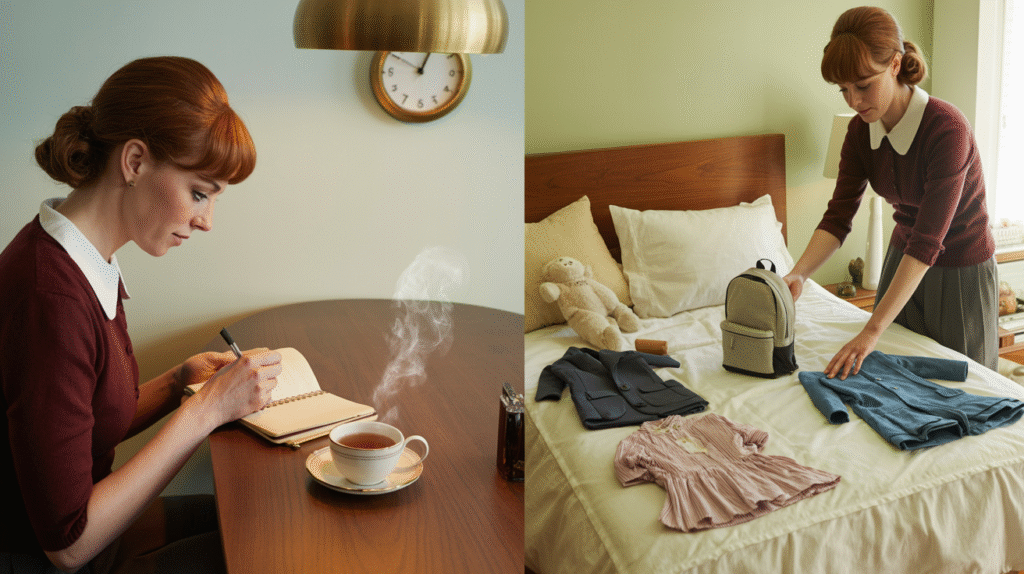
Write down whatever’s spinning in your head. Worries, to-dos, random thoughts. Once they’re on paper, your brain can stop holding onto them.
Then spend two minutes prepping for tomorrow: lay out clothes, pack lunches, set out what you’ll need in the morning. This removes one decision from tomorrow when you’re already at your limit.
The bare-minimum version: Write three things on a sticky note. Some nights, those three things are “survive,” “feed kids,” and “don’t yell.” All valid.
Step 3: Gentle Stretching (5 Minutes)
Research shows that gentle movement before bed reduces stress and improves sleep quality. Simple stretches activate your parasympathetic nervous system—your body’s “rest and digest” mode.
You don’t need to be flexible. You don’t need a yoga mat. You just need five minutes of telling your body the work is done.
Three stretches that actually help:

Child’s Pose: Kneel and fold forward, arms extended. Hold for 1 minute while breathing deeply. (Or 30 seconds. Or however long feels okay.)
Seated Forward Bend: Sit with legs extended, reach toward toes. Hold for 1 minute. Don’t worry about touching your toes. Just fold.
Legs Up the Wall: Lie with legs resting against a wall. Breathe slowly for 2-3 minutes. This one is magic for releasing the day.
The bare-minimum version: Lie on your back. Breathe. That counts.
Step 4: Put Devices Away (2 Minutes)
Blue light from screens suppresses melatonin—the hormone that signals sleep. Screen exposure delays sleep onset and reduces sleep quality.
The rule: avoid screens at least one hour before bedtime.
The reality: sometimes you’re going to scroll. And that’s okay.
Instead of scrolling: Read a physical book, listen to calming music, practice gentle journaling.

Instead of watching TV: Try a guided meditation, have a quiet conversation with your partner, enjoy a warm bath.
Make it easier: Charge your phone in another room. Use a traditional alarm clock. Remove the temptation to check “just one more thing.”
The bare-minimum version: Put your phone across the room instead of on your nightstand. Small change, real impact.
Step 5: Create a Sleep-Friendly Environment (2 Minutes)
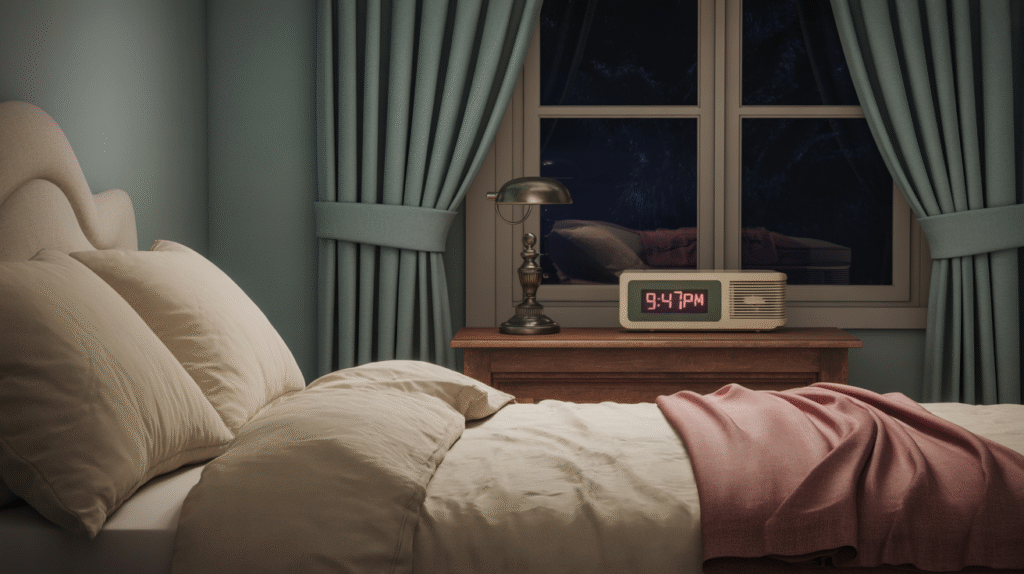
The ideal sleep temperature is around 65°F. A cool, dark, and quiet room enhances deep sleep and helps you stay asleep.
Three things that actually matter:
Temperature: Keep your bedroom between 60-67°F. If you can’t control the temperature, crack a window or use a fan.
Darkness: Use blackout curtains or an eye mask. If blackout curtains aren’t in the budget, a sleep mask from the drugstore works.
Sound: White noise machines or fans mask household noises. Or free white noise apps. Or a fan you already own.
The bare-minimum version: Turn off the overhead light. Close the curtains. That’s enough.
Step 6: Self-Soothing Touch (3 Minutes)
Gentle self-massage relaxes tense muscles and improves mood. This helps reduce night wakings and stress by activating your body’s relaxation response.
Even three minutes of self-care through touch can shift your nervous system from fight-or-flight to rest mode.
Three areas to focus on:

Neck & Shoulders: Use your fingertips to gently massage the base of your skull and tops of your shoulders in circular motions.
Hands & Wrists: Massage each hand, paying attention to the webbing between thumb and forefinger—a natural stress relief point.
Feet: Roll your feet over a tennis ball or massage the arches with your thumbs to release daily tension.
Enhancement: Use lavender or chamomile essential oil during your massage for added calm.
The bare-minimum version: Rub your own shoulders for 30 seconds. That’s self-care too.
What This Actually Looks Like
Some nights you’ll do all six steps and feel like you’re winning.
Other nights you’ll skip dinner curfew, scroll your phone until 11pm, and fall asleep in your clothes.
Both are fine.
The goal isn’t perfect consistency. The goal is having a framework available when you need it.
When you do it consistently: Within 1-2 weeks, your body begins to anticipate sleep as soon as you start your routine. Falling asleep becomes easier and more natural.
When you don’t: You haven’t failed. You’ve just had a night when other things mattered more.
The Permission You Need
You don’t need to do all six steps.
You don’t need to do them in order.
You don’t need to do them perfectly.
You don’t need to do them every single night.
You’re allowed to:
-
- Pick two steps and skip the rest
- Do the steps in whatever order makes sense
- Modify everything to fit your actual life
- Take a night off when you need to
These 10-15 minutes are yours. But they’re not mandatory. They’re not homework. They’re just tools available when you’re ready.
You deserve rest. Not because you earned it by completing a routine, but because you’re a person who needs sleep.
Start tonight if you want. Start next week if that’s better. Start with one step if six feels overwhelming.
Sweet dreams aren’t conditional on perfect routines. They’re available to you right now, exactly as you are.

5 Questions Busy Moms Actually Ask About Evening Routines
Q: What if my partner stays up late and I can hear the TV/their movement while I’m trying to sleep?
A: This is real and it’s frustrating. A few things that help: white noise app or fan to mask sound, explain to your partner that you need quiet after a certain time (they’re not mind readers), sleep with the door closed if possible, or use soft earplugs designed for sleeping. If none of that works, acknowledge that your sleep environment isn’t perfect and do what you can with what you have. Imperfect sleep in an imperfect environment still beats no routine at all.
Q: My kids don’t go to bed until 9 or 10pm. How am I supposed to have a wind-down routine when I’m still on duty?
A: You’re not. On nights when bedtime drags late, your routine is survival. But consider this: can you do steps 1-3 (meal curfew, brain dump, stretching) while your kids are winding down? Can you sit on the floor and stretch while they’re in the bath? Can you write tomorrow’s to-do list while they’re brushing teeth? Piggyback your routine onto theirs when possible. And on nights when that doesn’t work, skip it. The routine will be there tomorrow.
Q: I work night shifts. Does any of this apply to me or is this just for 9-5 moms?
A: This applies to anyone who sleeps, regardless of when. Adjust the timing to fit your schedule—your “evening” routine happens before whatever time you sleep, whether that’s 10am or 10pm. The principles are the same: give your body signals that it’s time to wind down, create a sleep-friendly environment, remove decisions from your tired brain. Your circadian rhythm might be different, but your need for rest isn’t.
Q: What if I fall asleep before I finish the routine? I’m usually out the second my head hits the pillow.
A: Then you don’t need a sleep routine—you need more sleep. If you’re falling asleep instantly, your body is telling you it’s severely sleep-deprived. The routine is for people who have trouble transitioning to sleep, not for people who are already exhausted. Your job is different: protect your sleep time, go to bed earlier when possible, and stop feeling guilty about how quickly you fall asleep. That’s not a problem. That’s your body doing exactly what it needs.
Q: I share a bedroom with my baby/toddler. How do I do a routine when I’m trying not to wake them up?
A: Modify for your reality. Do steps 1-4 (meal curfew, brain dump, stretching, devices away) before you enter the bedroom. Once you’re in the shared sleep space, focus on step 5 (environment—as much as you can control with a baby monitor glowing and a toddler who might wake up) and step 6 (quiet self-massage you can do lying down). Or accept that room-sharing means your routine looks different, and that’s okay. A partial routine beats no routine. And honestly? Some seasons of motherhood, survival is the routine.
Some blog articles may contain affiliate links to products or services for which we may receive a commission on transactions. Some of the content on this blog site may be assisted by A.I. generators.
Thank you for visiting our blog!