


Get Your Copy Today!
You’ve tried the apps. You’ve bought the planners with the color-coded tabs. You’ve pinned organizing systems on Pinterest that promised to change your life.
And here you are at 9 PM on a Tuesday, staring at a kitchen that somehow got messy again, wondering whose turn it is to take out the trash, feeling like the only person who remembers anything in this house.
What if I told you the solution isn’t another fancy app or expensive planner system? What if it’s something you probably already have on your computer?
The Unexpected Power of a Spreadsheet

I know what you’re thinking. Spreadsheets sound boring. Complicated. Like something your accountant uses, not something that could actually help you survive the daily chaos of family life.
But here’s what spreadsheets actually are: flexible, customizable, and yours to control. No subscription fees. No “upgrade to premium” pop-ups. No learning curve steeper than a mountain. Just rows, columns, and the freedom to make them work exactly how your brain works.
And when you’re a working mom in your 40s juggling a career, a household, maybe some health stuff that comes and goes, and a family that somehow expects dinner to appear every night? That flexibility matters more than any pre-built system ever could.
Why Spreadsheets Work When Everything Else Hasn’t
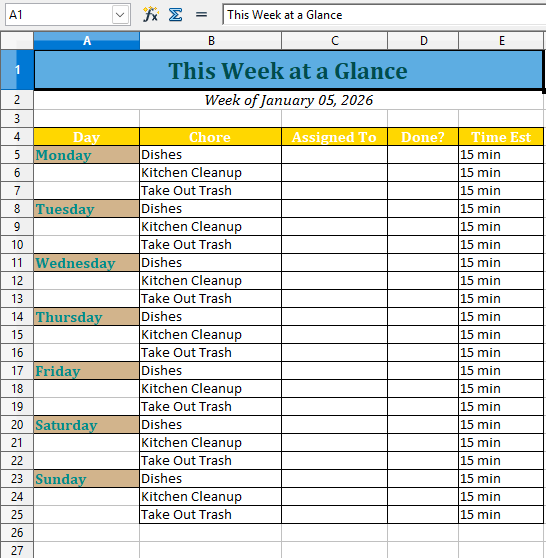
The problem with most organizing systems isn’t you. It’s that they were designed by someone else for someone else’s life. Someone who has time to update an app every single day. Someone whose energy levels don’t crash at 2 PM and force a complete recalculation of what’s actually possible tonight.
Spreadsheets don’t care about your energy level. They don’t judge you for not updating them perfectly. They sit there quietly, ready whenever you are, holding whatever information you need them to hold.
You can track chores without the system yelling at you about streaks. You can plan meals without someone else’s idea of what’s healthy staring back at you. You can organize your week in a way that makes sense to your actual life, not some Instagram fantasy version of it.
What You Can Actually Do With a Spreadsheet (Without Losing Your Mind)
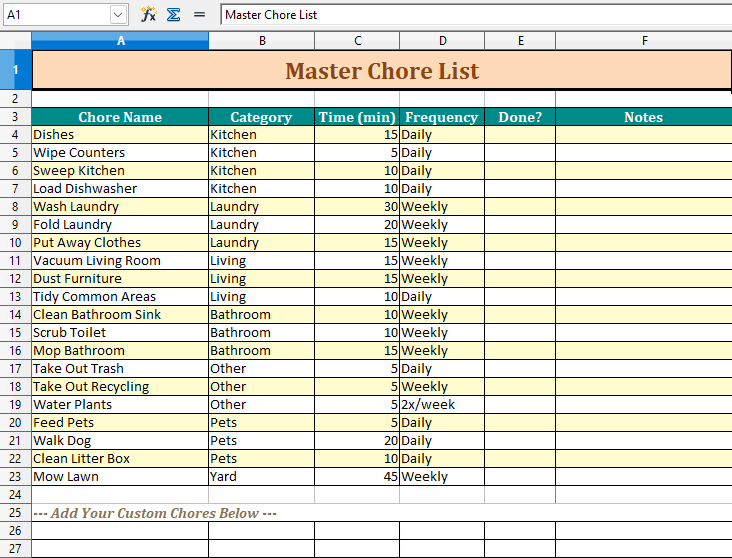
Let’s get practical. Here’s what a simple spreadsheet can handle for you:
Track who does what without being the memory keeper for everyone. Set up a chore rotation that shows whose turn it is. Stop being the only one who remembers the last time someone vacuumed. Let the spreadsheet be the bad guy.
See who’s carrying too much before everyone burns out. Add up time spent on tasks. Compare who’s doing what. Get actual data on whether things are fair or if one person (probably you) is shouldering way more than their share. Sometimes seeing it in black and white is what finally starts the conversation that needs to happen.
Plan meals when your brain is too tired to think. Keep a running list of what your family actually eats. Note which meals take 15 minutes versus an hour. Mark which ones you can make when you’re exhausted. Future-you will thank present-you for this gift.
Build in rewards that actually motivate people. Track completed tasks and let people see their progress. Add a simple point system if that works for your family. Make it visible when someone’s crushing it or when someone needs to step up.
The best part? You can change any of this tomorrow if it stops working. No calling customer service. No figuring out a new app. Just adjust the spreadsheet and keep going.
Why This Works Better for Real Life

Most organizing systems assume you have consistent energy and consistent time. They assume you can maintain elaborate color-coding systems and detailed tracking every single day.
You don’t live in that world. Some days you’re on fire and could organize the whole house. Other days, getting through a work meeting without falling asleep is the win.
Spreadsheets meet you where you are. Update them when you can. Ignore them when you can’t. They’ll still be there, still holding your information, not sending you guilt-inducing notifications about the gap.
They also don’t require everyone in your family to download an app, create a login, or figure out some new technology. Most people can look at a spreadsheet and immediately understand rows and columns. That’s it. That’s the whole learning curve.
The Real Win: Visibility
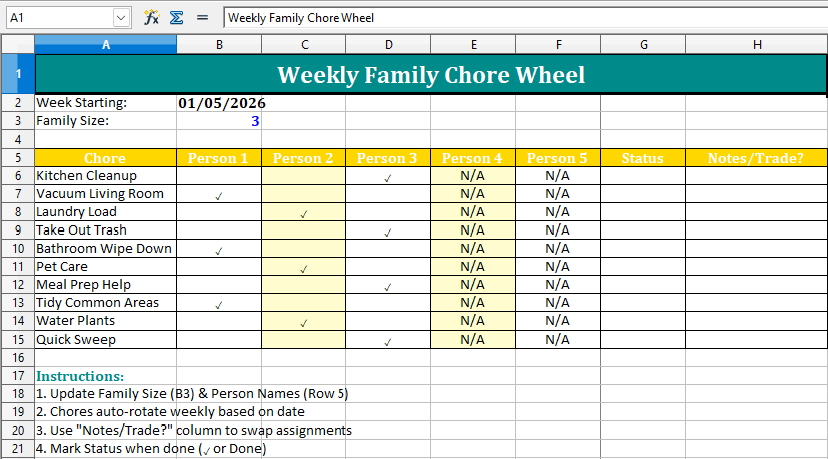
Here’s what happens when you move family management out of your head and into a spreadsheet: everyone can finally see it.
Your partner can see whose turn it is without asking you. Your kids can see what needs to be done without you nagging. You can see patterns you’ve been too exhausted to notice, like how you always end up doing more on weekends or how certain tasks never seem to get done at all.
That visibility changes things. Suddenly, it’s not you against everyone. It’s everyone looking at the same information and figuring out together how to make it work.
And when something isn’t working? You change it. Right there in the spreadsheet. No waiting for the app developer to add a feature you need. No working around someone else’s idea of how families should function.
Getting Started Without Overwhelming Yourself
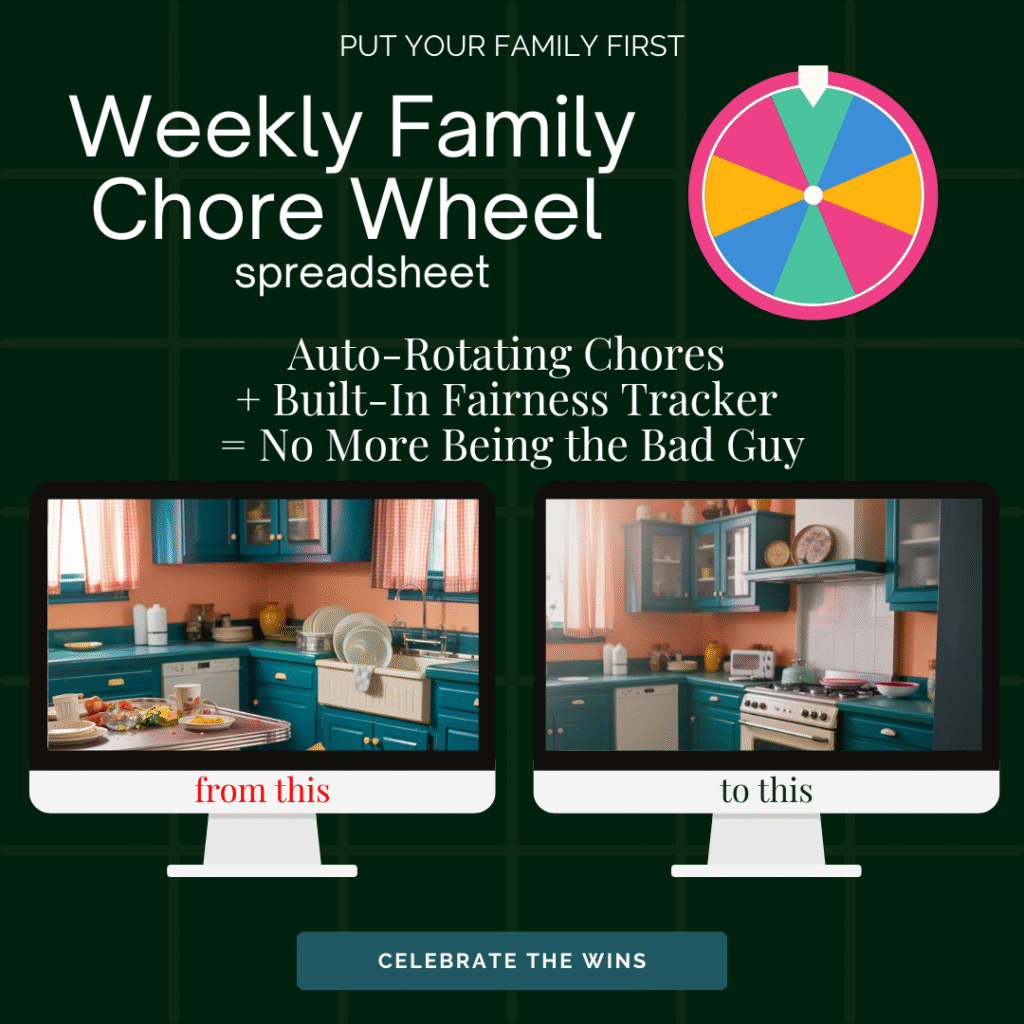
Get your copy today!
You don’t need to track everything on day one. Start with one thing. Maybe it’s just chores. Maybe it’s just dinner planning. Maybe it’s tracking who did what last week so you can finally have proof that yes, you actually are doing more than your share.
Build it simple. A few columns. A few rows. Information that genuinely helps you instead of information you think you’re supposed to track.
Use it for a week and see what happens. Adjust what doesn’t work. Keep what does. Let it evolve with your life instead of forcing your life to fit some predetermined system.
Because that’s the thing about spreadsheets for family organization: they work with you, not against you. They don’t require you to be better or more organized or more on top of things. They just require you to put information somewhere other than your exhausted brain.
And honestly? For a working mom who’s carrying the mental load for an entire household, that shift alone can feel like finally taking a breath after holding it for way too long.
Your family doesn’t need a perfect system. They need a system that actually works for your real life, with your real energy, on your real hard days. A simple spreadsheet might not look like much, but sometimes the simplest tools are the ones that actually make things different.
Start small. Start today. And let the spreadsheet carry some of that weight you’ve been carrying alone.
Get Your Copy Today!
Some blog articles may contain affiliate links to products or services for which we may receive a commission on transactions. Some of the content on this blog site may be assisted by A.I. generators.
Thank you for visiting our blog!